The run so far
I am West, and I build Hestia's Atlas on my own, while making the same cross-country move the app is designed to help with. Underneath the classes and the XP, what I am building is a dashboard for your life: one screen for the numbers that decide whether you actually get where you are going. Your life, seen as the adventure it is. This is how I got here, and why the whole thing is shaped like a game.
Continue here
Start your own runThirteen questions turn what you value into a character and a county to aim at.
The chapters
Chapter I
Character creation
Growing up in video games
I grew up in games, and mostly in RPGs. RuneScape and then Old School RuneScape, League of Legends, Path of Exile and its sequel, Factorio, Diablo III, Monster Hunter. Different worlds, same shape underneath: you start with nothing, you choose what to get good at, and the numbers go up because of something you actually did.
That started on Baca's computer. Baca is my grandfather, and his machine was the first PC I ever used growing up. RuneScape was the first PC game I ever played, and I played it right there at his desk. Someone had decided a computer was worth having, and that a kid was worth letting sit at it. Everything on this site runs back to that desk.
Somewhere along the way RPG stopped being a genre and became a layer. It is in MMOs and single-player campaigns, and it is in shooters too: nearly every game now hands you experience, levels, a build and a loadout. That layer is the part I never got tired of, and it turned out to be the part that transfers.
The clearest proof I have that the layer is real: I climbed League of Legends to Diamond in 2015. Over ten thousand hours, season after season, to get there, which is the least glamorous part and the part that matters. Nobody hands you that, and you cannot buy it. It is the same shape as everything on this site. You start with nothing, you pick what to get good at, and the number moves because of something you actually did.

The promotion itself: League of Legends, patch 5.13, 7 July 2015. Victory, and the dialog that ended a 10,000+ hour digital journey. Verified match history Chapter II
The redwoods
College in Northern California
I went to college in Northern California, up among the redwood forests, and studied business and computer science side by side. At the time they felt like two unrelated majors that happened to share a campus.
They were the two halves of this. One taught me to read a balance sheet and a cost-of-living table without flinching. The other meant that when I wanted a tool like this to exist, I could go and build it instead of waiting for someone else to.
Chapter III
The Bay
Starting a career in accounting and finance
Then I moved to the Bay Area and started a career in accounting and finance. Work came with structure: a calendar, reviews, a ladder I could see the rungs on. Everything outside of work did not.
That is where I first noticed the gap. I could tell you precisely where I stood on a close, and not at all where I stood on the rest of my life. The parts that mattered most were the parts nobody was tracking.
Chapter IV
The long haul
A move across the country, in progress
Right now I am making a big move across the country. It is the largest single thing I have ever planned, and it is made almost entirely of pieces that do not talk to each other: what it costs to land somewhere, what I need to be earning once I am there, what to do about certifications, and who I am going to miss.
This chapter is still open. Hestia's Atlas is what I built to keep it legible, and I am using it for the exact move it was designed for, which is the only reason I trust any of it.
The part nobody puts in the trailer
A career is the piece with a job title on it. Here is everything that was running at the same time: five separate things, none of which arrive with a progress bar.
The crossing
Relocating
Cash to land somewhere, an income floor once you are there, and a cushion for the month that goes sideways.
Attunements
Professional certifications
The exams that gate a career. Long, expensive, and scheduled entirely by you. Nobody sends a reminder.
The supply run
Managing a budget
The unglamorous one, and the one that quietly decides which of the others are even available to you.
Your party
Keeping up relationships
The one that loses to everything else, because nothing on it is ever technically due.
Downtime
Hobbies, games included
Not the reward for finishing the other four. A stat you have to keep up, the same as the rest of them.
Hold five of those at once and it stops feeling like a life and starts feeling like a tab you forgot to close. That is what this app is actually pointed at: not any one of them, but the fact that they all run at the same time, in five different places, and nothing anywhere puts them on one screen.
What I am actually building: a dashboard for your life
Every one of those five things produces numbers. The problem is never that the numbers do not exist. It is that they live in a bank app, a spreadsheet, an exam portal, a marketplace, and your own head, and no two of them have ever been in the same room. So you can be doing well and not feel it, or drifting and not notice.
The car has this solved. You do not audit your engine. You glance at the dash and the needles tell you where you stand. That is what Hestia's Atlas is: one screen that holds the readings of a life together, so you can open it and see whether you are actually getting closer to the thing you are aiming at.
So here is the concrete version, one card per surface. The Explore map and the thirteen-question forge came first: they are how the character and the target county on my sheet exist at all. What follows is the week that runs on top of them, mine, in the order I actually open things.
Where the dashboard reads from a surface, the card names the reading it feeds. None of it is a prediction, and none of it can be edited from that screen: every reading belongs to the page that owns it, and the dashboard only reads.
Treasury and Provisions
The Keep's money panels
My first stop on a normal day. I import bank statements in a batch and type the odd row by hand between imports, and the Treasury keeps the ledger: what came in, what went out, and the cash leftover. Provisions reads the same numbers back as time, which is the version I actually feel: how many months my stores would carry me.
On your dashboard: The ledger · expenses against income: what comes in, what goes out, and what that leaves you putting away each month.
The Jobs Board
Real postings in the target county
Part of my weekly rotation. It aims my line of work at the county I am moving to, with live postings, so the income floor I am planning against stays a real number and not a hope.
The Housing Board
Rentals and homes for sale at the target
The other half of the weekly scout. It holds rental and for-sale searches for my target county at the listing sites themselves, banded around the county's own published median, so I watch the market I am about to enter instead of guessing at it.
The Market
The sell-down before the move
Everything I will not take with me is a listing waiting to happen. Proceeds go straight into savings, and savings are the runway, so this is one of the few levers that moves the headline number quickly.
On your dashboard: The stall · what you have actually sold, at a glance.
The Journey
The move quests
The quest board holds the move itself: move-in cash, an income floor, and a cushion for the month that goes sideways. Each target is priced from my target county's published data, and each pays its experience once, ever.
On your dashboard: The runway · months you can cover, here and there: how long your money lasts where you live now, next to how long it would last in the county you are aiming at.
Training
The Enrolled Agent exam, in progress
My current climb. The exam that gates the next rung of my career sits in the Training panel, and the studying happens there rather than in a tab I forgot to close.
On your dashboard: The next step · where you are in a certification: the last part you finished, if any, and the one thing in front of you.
The Guild
Your rung and the ladder of your line of work
The shelf rather than a weekly stop: degrees and certifications live here once they are earned, beside the full ladder of the line of work they belong to.
On your dashboard: The trophy case · degrees and certifications earned: the schooling and the credentials already behind you.
One panel in the Keep, University, is still reserved, and it says so on its face rather than promising content it does not have. Everything else above is open right now. Chapter IV is still being written, and these are the pages it is being written on.
Why life can be framed as a game
A dashboard about money and exams is one bad decision away from feeling like a performance review. There are already a hundred apps that will give you a checklist, and a checklist is mostly a list of ways to be behind.
Games solved this a long time ago. A good RPG never tells you that you are failing. It tells you where you are, what you are working toward, and what the next thing you do is worth. You can put it down for a month and come back to exactly the character you left. That is the feeling I was after, and it turns out to be a set of rules rather than a coat of paint.
Experience is for things you actually did
Every point of XP is paid once and never taken back. There is no mechanic anywhere in this app that can reduce a number you have already earned.
Your class is your real career
It maps to an actual occupation, and the wages attached to it come from published federal data rather than a guess. It also never touches how a county scores for you. The map does not care what class you are.
Quest targets come from a real place
Move-in cash, income floor, cushion, down payment. Each one is built from your target county's own published data, not from a rule of thumb.
No deadlines, no streaks, no loss states
Nothing here expires, nothing punishes you for a quiet month, and there is no counter you can break. Life supplies enough urgency on its own.
The runway moves, and I will tell you when it moves down
If rent rises or your income drops, your runway gets shorter, and this app will say so plainly instead of hiding it. What it will not do is treat that as a failure. Nothing you have earned is taken away, nothing expires, and there is no streak to break. A number that moved is a fact about the world, not a score you lost.
Your life, seen as the adventure it is
If this whole page had to shrink to one sentence, that would be the sentence. A line from a book says the longer version better than I can. It was written about tools, and I read it about life:
“We must re-enchant our hammers – all our tools – so they are less like the carpenter's, and more like Thor's. More like thunderstones.” — James Bridle, New Dark Age (2018)
That is what this site tries to do for a life. Left alone, a life flattens into a list of daily tasks and weekly budgets, and nothing on the list is wrong: the limits are real, and this site never hides them from you. Held the right way, the same life reads as a hero's adventure. You know your budget and you know your numbers, and you can also see the opportunities the world is holding open for you, if you decide to set out after them. The enchantment is not a coat of paint over the data. It is the reason to look at the data at all.
Why her name is on the door
When a Greek city founded a colony, the settlers didn't just pack and leave. They took fire from the mother city's hearth, the sacred flame of Hestia, goddess of hearth and home. They carried it the whole way and used it to light the first hearth of the new settlement. The ritual said something the checklist never does: a move done right isn't leaving home. It's carrying your flame somewhere new.
Atlas holds the sphere. He's in our logo, carrying the heavens. Hestia keeps the flame. This product is the map between hearths: where your fire burns now, and every county where it could burn next. That's why progress here glows amber: it's a flame color, and the thing it measures is how ready you are to carry yours.
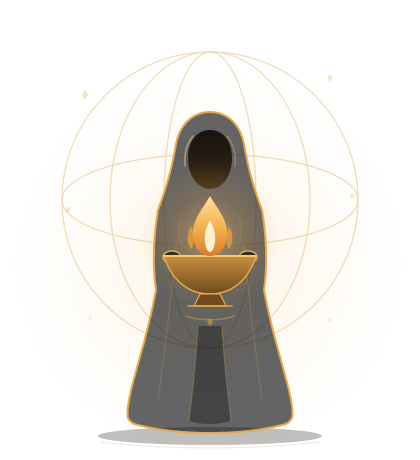
In ancient Greece, every household's first and last offering belonged to Hestia. Her fire was the center of every home, and the saying was simply that Hestia comes first. A sixth-century tapestry, woven centuries after her altars should have gone cold, still calls her Hestia Polyolbos, full of blessings, because the keeper of the hearth is the one who brings every good thing into a home.
And yet she is the Olympian people know least. She never appears as a character in the Iliad or the Odyssey. In most rollcalls of the Twelve her seat has gone to Dionysus. The usual telling is that she gave it up rather than see a fight over it, which tells you everything about her. But she never actually left. She was always there in the form of the hearth itself: sometimes in the background, sometimes at the very center of the scene, and almost never named.
That is exactly how the biggest goals in a life work, and it is the reason her name is on this site. Where you stand on the things that decide your next chapter (what a county actually costs, what a certification takes, what a first home or a new family needs the numbers to look like) is always there in the background, and almost never named out loud. The data exists; there is more of it than any one person can hold. Hestia's Atlas exists to name the thing that was always sitting at the center of the room.
My favorite proof that the unnamed goddess still does the welcoming: in the Odyssey, when a stranger who has lost everything washes ashore, the welcome happens at the hearth. He sits down by the fire and is taken in. The goddess goes unnamed; the hearth does the work. That is what this site is meant to be. An open door with a warm fire inside, that you can sit down at during any chapter of your life, and while you stay: learn, organize, and put a name on the next goal.
Two things I love too much to leave out. The flame for every modern Olympic Games is still kindled at ancient Olympia, where the sanctuary once kept a perpetual fire on its hearth. And the lines at the base of the Statue of Liberty read, to me, like Hestia standing in New York Harbor:
“Keep, ancient lands, your storied pomp!” cries sheWith silent lips. “Give me your tired, your poor,Your huddled masses yearning to breathe free,The wretched refuse of your teeming shore.Send these, the homeless, tempest-tost to me,I lift my lamp beside the golden door!”— Emma Lazarus, “The New Colossus” (1883)
Where the numbers come from
Median rent is US Census ACS 5-year, the same number the Census publishes, which you can look up yourself. Health measures come from County Health Rankings, hazard risk from FEMA, air quality from the EPA. Where we compute something rather than quote it, the measure says so, and every one of the 45 measures names its source.
Where this actually is
One person, unfinished, and I would rather say that than let you find it out. The patch notes are written by hand as work lands, so they are an honest record of what shipped rather than a roadmap. The forums are where I read what is broken, including “this number looks wrong”, which is the single most useful thing anyone has sent me.
Every mythological name on this site sits over a plain-English feature, and the glossary translates them all.
Thanks for reading this far. Go make a character.
— West